Choosing the correct resuscitation training in San Pablo, CA can feel confusing when facing acronyms like BLS, ACLS, and PALS. While all three programs are developed by the American Heart Association (AHA) and share foundational life-support principles, they serve entirely different clinical scopes, emergency scenarios, and professional credentials.
The core distinction lies in patient age, intervention intensity, and provider scope: Basic Life Support (BLS) focuses on fundamental CPR, bag-valve-mask ventilation, and AED use for adult, pediatric, and infant patients; Advanced Cardiovascular Life Support (ACLS) addresses adult cardiac arrests, dangerous arrhythmias, and pharmacology; and Pediatric Advanced Life Support (PALS) specializes in pediatric respiratory distress, shock, and pediatric resuscitation algorithms.
Key Takeaway: BLS provides foundational, non-invasive resuscitation skills required for almost all healthcare roles. ACLS builds on BLS to add cardiac rhythm analysis, IV/IO medications, and advanced airway management for adult acute care providers. PALS targets specialized assessment, vascular access, and emergency resuscitation specifically for pediatric and infant patients.
Comparing Core Resuscitation Programs Side-by-Side
To understand which track fits your career path, it helps to examine how the clinical depth, target patients, and technical requirements vary across each American Heart Association course.
| Feature | Basic Life Support (BLS) | Advanced Cardiovascular Life Support (ACLS) | Pediatric Advanced Life Support (PALS) |
| Primary Patient Focus | Adults, Children, and Infants | Adult Patients Only | Children, Toddlers, and Infants |
| Core Interventions | Chest Compressions, AED, Bag-Valve-Mask | Electrocardiogram (ECG) Analysis, Meds, Intubation | Evaluative Triangle, IO Access, Resuscitation Meds |
| Required Prerequisites | None (Basic clinical understanding helpful) | Active AHA BLS Certification & Rhythm Recognition | Active AHA BLS Certification & Pediatric Pharmacology |
| Primary Target Roles | RNs, CNAs, EMTs, Dental Teams, Students | ICU & Emergency RNs, MDs, Paramedics, Anesthesia | PICU, NICU, Emergency, & Pediatric Clinical Staff |
| Certification Period | 2 Years | 2 Years | 2 Years |
What is BLS (Basic Life Support)?
The BLS CPR certification course provides the basic standard of emergency cardiac care used throughout hospitals, outpatient clinics, and pre-hospital environments. It emphasizes immediate recognition of sudden cardiac arrest, high-quality chest compressions, proper ventilation, and early defibrillation.
Clinical Focus of BLS Training
- High-quality CPR for adults, children, and infants using single-rescuer and multi-rescuer protocols
- Operation of Automated External Defibrillators (AEDs) on adult and pediatric victims
- Effective ventilation using barrier devices and bag-valve-mask (BVM) respirators
- Relief of foreign-body airway obstructions (choking) for conscious and unconscious patients
Who Needs BLS in San Pablo?
BLS is the baseline entry credential for virtually all clinical healthcare providers. This includes Registered Nurses (RNs), Licensed Vocational Nurses (LVNs), Certified Nursing Assistants (CNAs), Medical Assistants, Emergency Medical Technicians (EMTs), Dentists, Dental Hygienists, Physical Therapists, and clinical students fulfilling school prerequisites.
How Does ACLS Expand on Basic CPR Skills?
While BLS keeps oxygenated blood circulating manually during cardiac arrest, ACLS aims to restore a spontaneous heart rhythm through advanced medical management. You must hold an active BLS card to participate in ACLS, as high-quality compressions remain the underpinning of advanced cardiac resuscitation algorithms.
Advanced Clinical Concepts in ACLS
- Electrocardiogram (ECG) rhythm recognition for lethal arrhythmias, bradycardia, and tachycardia
- Administration of resuscitation drugs such as epinephrine, amiodarone, adenosine, and atropine
- Airway management using supraglottic airways or endotracheal intubation
- Management of acute coronary syndromes (ACS) and acute ischemic stroke protocols
- Targeted temperature management and post-cardiac arrest care to preserve neurological function
Healthcare Roles Requiring ACLS
ACLS is mandated for professionals operating in critical, acute, or emergency care environments where advanced cardiac stabilization is performed. Common roles include Emergency Department physicians and nurses, Intensive Care Unit (ICU) staff, Cardiac Cath Lab specialists, Telemetry nurses, Paramedics, and Surgical teams.
Why PALS Focuses Exclusively on Pediatric Patients
Pediatric emergencies differ fundamentally from adult cardiac events. In adults, cardiac arrest usually stems from underlying cardiovascular disease. In infants and children, cardiac arrest is most often the end stage of progressive respiratory failure or uncompensated shock. PALS equips providers to intervene long before a child reaches full cardiac arrest.
Specialized Skills Taught in PALS
- Rapid assessment using the Pediatric Assessment Triangle (Appearance, Work of Breathing, Circulation)
- Identification and management of upper airway obstructions, lower airway distress, and lung tissue disease
- Early intervention for hypovolemic, distributive, cardiogenic, and obstructive shock
- Vascular access via intraosseous (IO) needles when intravenous access is unobtainable
- Pediatric resuscitation pharmacology and weight-based dosing calculations
Clinical Settings Demanding PALS Credentials
PALS certification is necessary for healthcare workers who routinely care for pediatric populations in urgent or emergency settings. This includes Pediatric ICU (PICU) nurses, Emergency Department personnel, Pediatricians, Family Practice providers treating young children, Urgent Care staff, and Paramedics serving communities with high pediatric transport demands.
Navigating Certification Requirements in Contra Costa County
Healthcare personnel working in San Pablo and neighboring East Bay communities must align their certifications with local facility mandates. Key regional medical hubs—such as Kaiser Permanente Richmond Medical Center, Sutter Delta, and nearby community clinics along the San Pablo Avenue corridor—maintain strict credential guidelines for clinical staff.
- Acute Care Hospitals: RNs working in telemetry or step-down units often need both BLS and ACLS. Staff deployed to emergency departments or float pools frequently carry all three cards (BLS, ACLS, and PALS).
- Outpatient & Urgent Care Centers: Providers in primary care clinics across San Pablo, Pinole, and El Cerrito generally maintain BLS, while those performing conscious sedation procedures require ACLS or PALS based on patient age.
- Allied Health Students: Nursing students attending East Bay colleges must secure a valid BLS credential prior to starting clinical rotations at local medical facilities.
Clinicians residing in San Pablo, Pinole, or Hercules, as well as those commuting from nearby El Cerrito CPR certification classes or Hercules AHA training courses, often schedule renewals to align their BLS and advanced cards within the same cycle.
Completing Resuscitation Courses in San Pablo
Safety Training Seminars provides official American Heart Association courses to assist local healthcare professionals, students, and safety teams in completing their BLS, ACLS, PALS, and First Aid certifications.
Training Center Address
Safety Training Seminars San Pablo CPR Training Center Address: 2090 23rd Street, Room 8, San Pablo, CA 94806
Located right off 23rd Street near major East Bay corridors, this training center serves clinicians, emergency responders, childcare workers, and residents from San Pablo, Pinole, Hercules, El Cerrito, Martinez, and nearby West Contra Costa communities.
Steps to Register for the Correct Class
- Check Employer Requirements: Confirm whether your facility or academic program requires American Heart Association (AHA) credentials.
- Verify Prerequisites: Ensure your BLS card is active before enrolling in an ACLS or PALS initial or update class.
- Select Your Training Format: Choose between full instructor-led classroom sessions or blended learning options (HeartCode® online modules followed by an in-person skills evaluation).
- Plan Renewal Timing: Complete your course prior to the end of your expiration month to prevent gaps in your authorization to practice.
For providers working near Martinez ACLS course locations or living around Lafayette BLS certification options, accessible scheduling makes maintaining current cards straightforward.
Frequently Asked Questions
Can I take ACLS and PALS at the same time?
While you can schedule them within the same week, they are taught as separate courses with distinct handbooks, exams, and skills tests. Both courses require a current AHA BLS card as a prerequisite before you begin training.
How long are AHA BLS, ACLS, and PALS certifications valid?
All American Heart Association BLS, ACLS, and PALS course completion cards are valid for two years. Certification extends through the final day of the month in which the card was issued.
Will hospital systems in Contra Costa County accept purely online CPR cards?
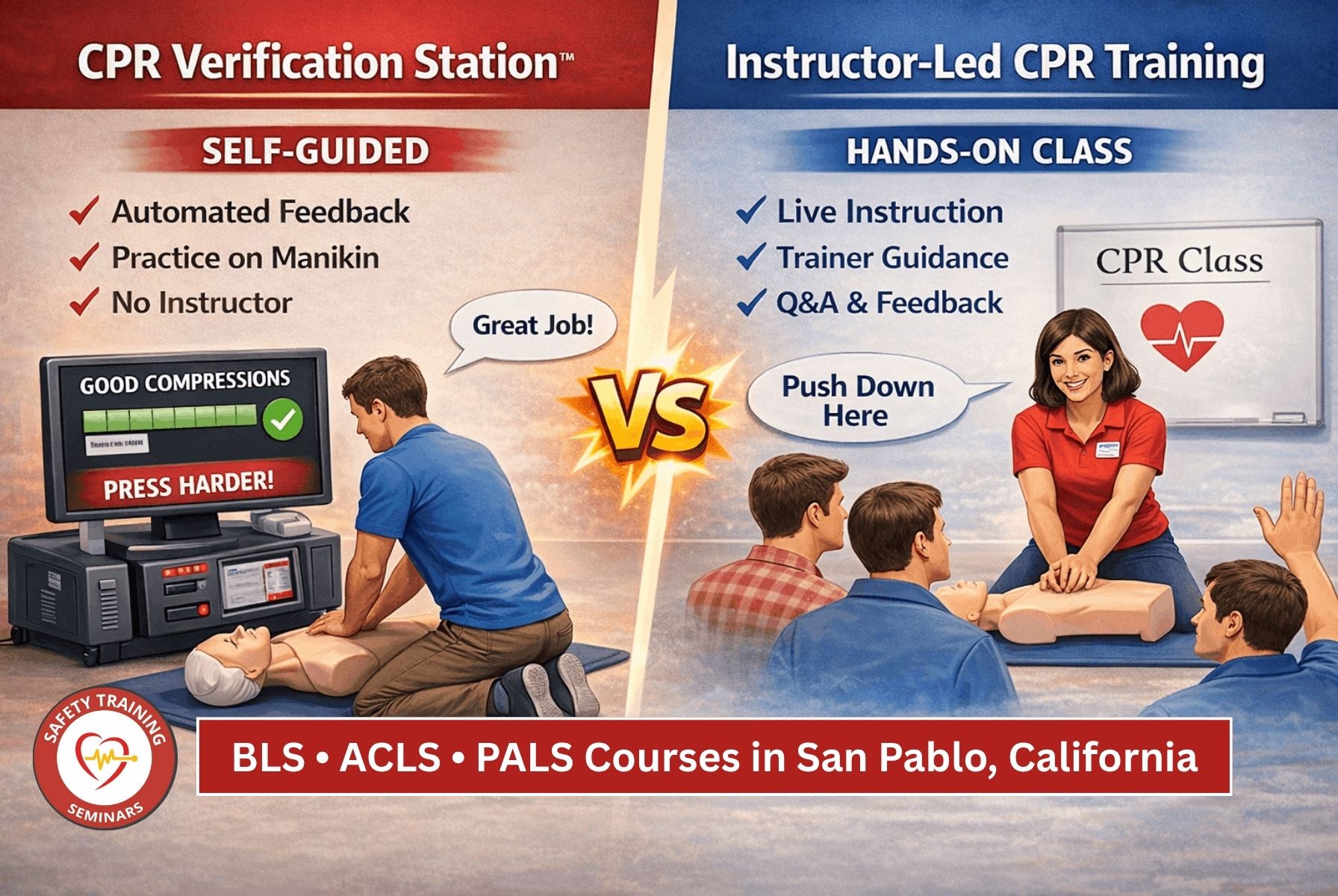
Most clinical employers, nursing programs, and state licensing boards require hands-on skills verification on physical manikins. Purely online certificates without an in-person skills evaluation with an instructor or voice-assisted manikin are generally rejected by healthcare facilities.
What should I bring to an ACLS or PALS course in San Pablo?
Students attending advanced courses should bring their current AHA BLS card, the appropriate AHA student provider manual (or eBook), and their completed mandatory pre-course self-assessment score sheet.
Choosing Your Path to Certification
Determining whether you need BLS, ACLS, or PALS depends on your clinical license, your care setting, and the age of the patients you treat. BLS provides the universal baseline for basic resuscitation, while ACLS and PALS deliver advanced emergency protocols tailored to adult cardiac events or pediatric respiratory and circulatory crises.
Before enrolling, verify the exact certification requirements dictated by your employer, school, or licensing board. Healthcare providers and students can review upcoming course dates, select blended or classroom formats, and reserve their seats directly on the San Pablo CPR location and schedule page.