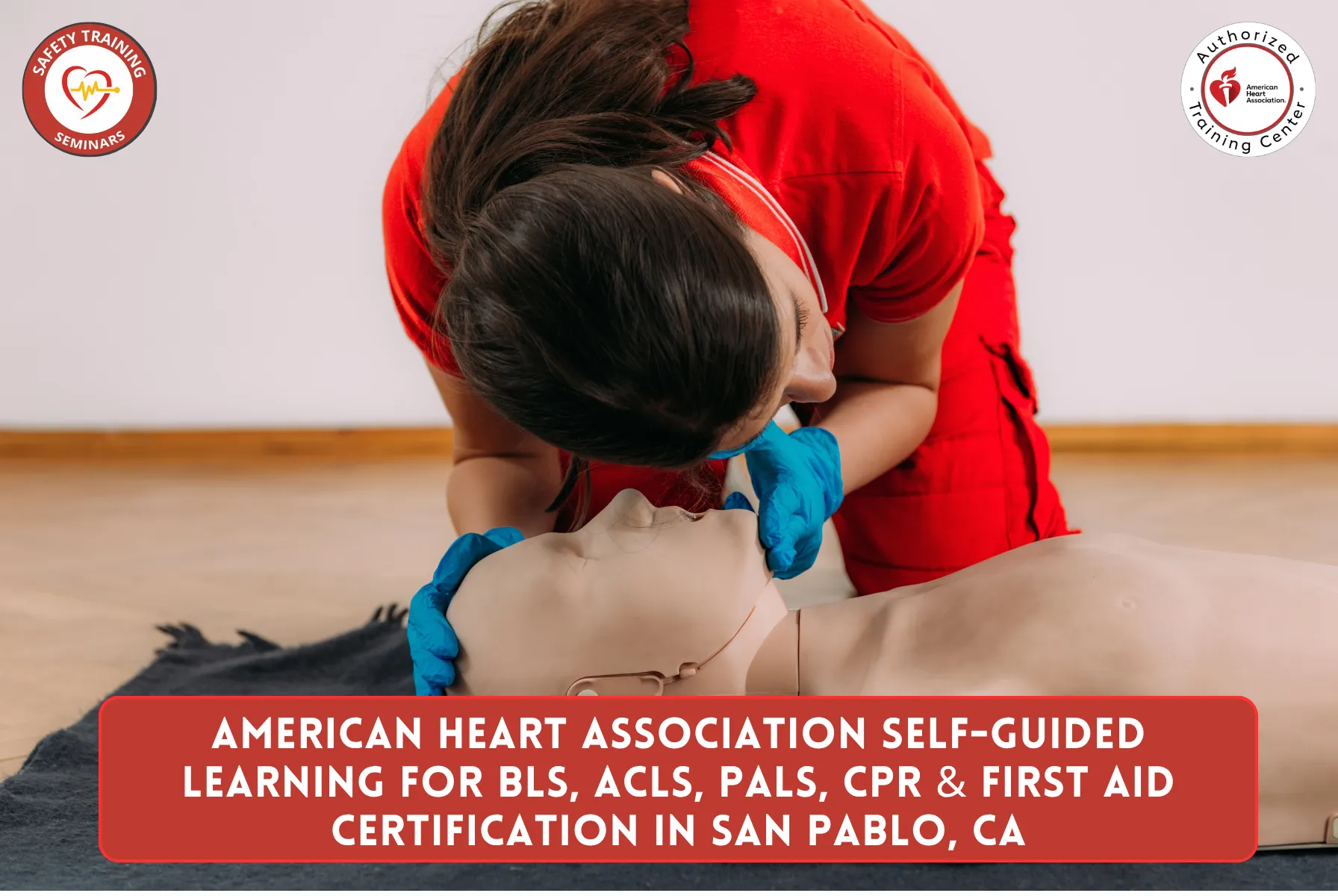
For healthcare workers, students, workplace employees, and community members in San Pablo, California, finding the right American Heart Association training format can be just as important as choosing the course itself. American Heart Association Self-Guided Learning is designed for learners who want more control over when and how they complete their training while still addressing applicable hands-on skills requirements.
Depending on the course, Self-Guided Learning can provide a combination of independent online education and hands-on practice or skills verification. Options may include BLS, ACLS, PALS, CPR, AED, and First Aid training. The important point is that Self-Guided Learning is not simply a course completed entirely online. For applicable AHA Self-Guided Learning courses, the hands-on component remains part of the training process.
Key Takeaway
AHA Self-Guided Learning can be a practical option for San Pablo learners who need flexibility without giving up the applicable hands-on portion of training. The course you select should be based on your professional role and the requirements set by your employer, school, healthcare organization, or other relevant authority.
What Does AHA Self-Guided Learning Mean?
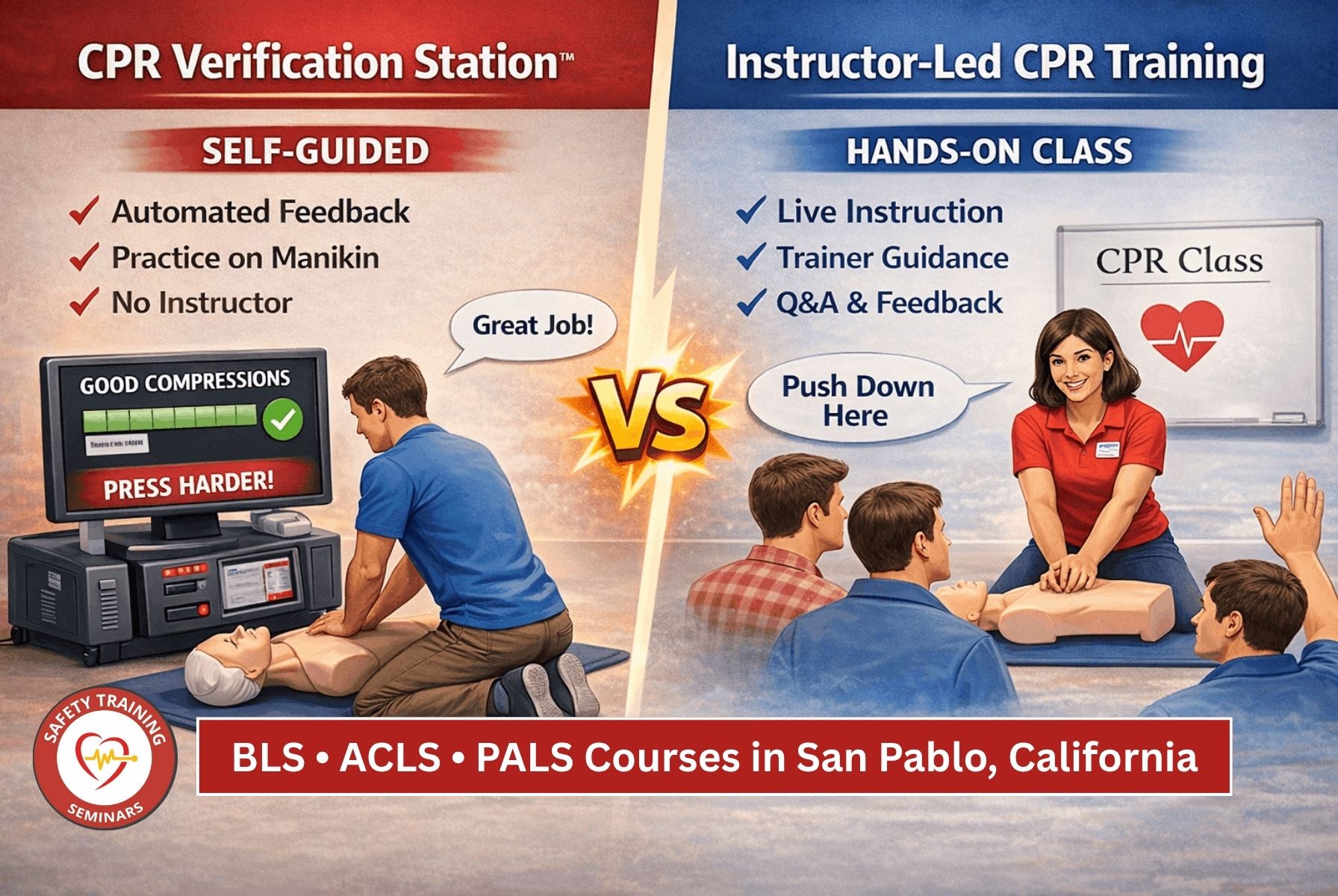
Self-Guided Learning is an AHA training delivery format in which learners complete the cognitive portion independently and then complete the applicable hands-on component at an approved verification station. The American Heart Association describes this format as an option for learners and employers who need greater scheduling flexibility.
The distinction matters because several training formats can include online education, but they do not all work the same way.
With Self-Guided Learning, a learner generally:
- Chooses the course appropriate for their role.
- Completes the required educational material independently.
- Attends the applicable hands-on practice and skills portion.
- Completes required skills verification or testing.
- Receives the applicable course completion documentation when the course requirements have been successfully completed.
For BLS, ACLS, and PALS, the AHA specifically describes Self-Guided Learning as combining online cognitive learning with a hands-on skills session at an approved CPR Verification Station.
That makes it different from an online-only course. If your employer or school requires an AHA course that includes hands-on skills, simply completing an online class may not satisfy that requirement.
BLS Self-Guided Learning in San Pablo
Basic Life Support, commonly called BLS, is generally intended for healthcare professionals and other learners whose roles call for healthcare-focused basic life support training.
That can include nurses, physicians, EMTs, paramedics, medical assistants, dental professionals, nursing students, and other healthcare personnel, although requirements vary by job and organization.
For someone searching for BLS classes in San Pablo, Self-Guided Learning may be useful when work, school, clinical responsibilities, or commuting make a fixed classroom schedule difficult. The AHA’s BLS Self-Guided Learning format combines independent cognitive learning with a hands-on skills session at an approved verification station.
Before enrolling, check whether your employer or educational program requires a particular BLS course format or completion card.
For local options, you can review the available BLS and CPR classes in San Pablo and compare the course information with your specific requirement.
ACLS Training for San Pablo Healthcare Professionals
Advanced Cardiovascular Life Support, or ACLS, is intended for healthcare professionals involved in managing adult cardiovascular emergencies. It is more specialized than general CPR training and is normally relevant to healthcare roles where advanced resuscitation knowledge and skills are part of the job.
The AHA offers ACLS Self-Guided Learning through its HeartCode Complete format. Learners complete the cognitive component independently and then complete hands-on skills practice and testing at an approved CPR Verification Station.
A San Pablo nurse, physician, paramedic, or other appropriate healthcare professional who needs ACLS should confirm the exact requirement before selecting a course. The fact that someone works in healthcare does not automatically mean ACLS is the correct course for that person.
PALS Self-Guided Learning in San Pablo
Pediatric Advanced Life Support, or PALS, is focused on emergency care involving infants and children. It is intended for appropriate healthcare professionals who may respond to pediatric emergencies, including personnel working in emergency, intensive-care, critical-care, and other settings where pediatric patients are regularly encountered.
PALS Self-Guided Learning gives eligible learners another way to approach the training requirement. The AHA’s HeartCode Complete PALS format combines online learning with hands-on practice and skills testing through an approved CPR Verification Station.
For San Pablo healthcare professionals considering PALS classes, the key question is not simply whether the course is available online. Instead, confirm that the complete training format matches what your employer, clinical placement, or educational program requires.
CPR, AED and First Aid Training
CPR, AED, and First Aid courses are often more appropriate for people outside specialized healthcare roles. Potential learners include teachers, childcare providers, coaches, fitness professionals, workplace employees, caregivers, parents, and community members.
The AHA provides Self-Guided Learning options for Heartsaver training as well. For Heartsaver First Aid CPR AED, the current AHA information describes Self-Guided Learning as self-paced online education followed by hands-on practice and a skills session using an approved training simulation station.
This can be particularly relevant for workplace teams operating different shifts or people who need more flexibility than a traditional classroom schedule allows.
If you are searching for CPR classes in San Pablo or First Aid training, do not automatically select a healthcare-provider course simply because it includes CPR. Start with the requirement you have been given and choose the corresponding AHA course.
Which AHA Course Should You Choose?
A simple comparison can help narrow the options:
| Course | Typical audience |
| BLS | Healthcare professionals and appropriate healthcare students |
| ACLS | Healthcare professionals involved in adult cardiovascular emergency care |
| PALS | Healthcare professionals involved in pediatric emergency care |
| CPR/AED | General public and workplace audiences |
| First Aid | Workplace, education, childcare, community, and general audiences |
This table is a starting point rather than a universal rule. Employers, schools, healthcare organizations, licensing bodies, and training programs may have their own requirements.
For example, AHA guidance states that BLS is not automatically included in ACLS and that ACLS learners are expected to be proficient in BLS skills. Training Centers may also have their own requirements.
When uncertain, ask the organization that requested your training: Which AHA course do I need, and which completion format will you accept?
Self-Guided Learning vs. Classroom vs. Online-Only
The differences become easier to understand when the formats are placed side by side.
Self-Guided Learning:
The learner completes the cognitive portion independently and then completes the applicable hands-on practice and skills verification at an approved station. This format emphasizes flexibility and learner-controlled scheduling.
Traditional classroom training:
The learner attends an instructor-led course where the instructor conducts the educational portion and hands-on practice/testing within the classroom setting.
Online-only training:
The learner completes training digitally without the applicable in-person hands-on component. This may not satisfy a requirement that specifically calls for hands-on skills practice or an accepted AHA course format.
So, Self-Guided Learning should not simply be interpreted as “CPR online.” It is a distinct training approach that combines independent learning with the applicable practical component.
Why Self-Guided Learning Can Work Well for San Pablo Learners
San Pablo learners can have very different reasons for choosing a flexible format. A nursing student may need to fit training around classes and clinical responsibilities. A healthcare employee may work rotating shifts. A teacher or childcare professional may need training without committing to a long fixed classroom schedule.
The same consideration applies to people who travel between San Pablo and nearby communities for school, work, or family responsibilities. A flexible learning format can reduce the need to rearrange an entire schedule around the cognitive portion of a course.
That does not mean Self-Guided Learning is automatically the right choice. If you learn better through direct instructor interaction, traditional classroom training may suit you better. The goal is to match the training format with both your learning preference and the requirement you need to satisfy.
Safety Training Seminars in San Pablo
For learners who want to investigate a local option, Safety Training Seminars provides a San Pablo training location where readers can review available CPR and BLS-related course options. The local training center address is 2090 23rd Street, Room 8, San Pablo, CA 94806.
Before registering, review the specific course page, confirm whether the available format matches your needs, and verify any requirements provided by your employer, school, or healthcare organization.
You can also review local ACLS and PALS training options when your professional role calls for advanced cardiovascular or pediatric emergency training.
Why Choose Safety Training Seminars for CPR and BLS Training in San Pablo?
Choosing a training provider should begin with course fit rather than promotional claims. Safety Training Seminars gives San Pablo-area learners a local starting point for reviewing CPR and BLS training options and determining which course may correspond to their professional or workplace needs.
A local training option can also make it easier to investigate the practical portion of training instead of assuming that an online course alone will meet the requirement.
For people comparing options, useful questions include:
- Is this the specific AHA course my employer or school requested?
- Does the course include the hands-on component I need?
- What completion documentation is provided?
- Is the course intended for my professional role?
- Do I need BLS, ACLS, PALS, CPR/AED, or First Aid?
- Does my organization have a specific renewal or course-format requirement?
These questions are more useful than choosing a course solely because it appears first in a search result.
Practical Steps Before Enrolling
Before selecting an AHA Self-Guided Learning course in San Pablo, take a few minutes to confirm the requirement.
First, identify the course name requested by your employer, school, clinical program, or organization. Next, determine whether they require a particular AHA course completion card or training format. Then compare Self-Guided Learning with classroom or blended options based on your schedule and preferred learning style.
If the requirement is unclear, ask before purchasing or registering. A few minutes of verification can prevent enrolling in a course that does not match the requirement.
Frequently Asked Questions
Is AHA Self-Guided Learning the same as taking a CPR course entirely online?
No. AHA Self-Guided Learning combines independent cognitive learning with an applicable hands-on component. For BLS, ACLS, and PALS, the AHA describes the hands-on portion as taking place at an approved CPR Verification Station.
Can healthcare workers in San Pablo use Self-Guided Learning for BLS?
Yes, where the appropriate AHA Self-Guided Learning option is available. BLS Self-Guided Learning combines online cognitive education with a hands-on skills session. Healthcare workers should still confirm that the format satisfies their employer or school requirement before enrolling.
Is ACLS appropriate for every healthcare worker?
No. ACLS is intended for healthcare professionals involved in adult cardiovascular emergency care. Whether an individual needs ACLS depends on their role, workplace, and other requirements. When in doubt, verify the requested course with the employer or healthcare organization.
Can a San Pablo nursing student choose BLS Self-Guided Learning?
Potentially, yes. BLS is commonly relevant to healthcare students, but the student’s nursing program determines which course and format are acceptable. Students should confirm the requirement with their school or clinical program before registering.
Does PALS Self-Guided Learning include hands-on training?
Yes. The AHA’s Self-Guided Learning format for PALS combines online learning with hands-on practice and skills testing through an approved CPR Verification Station.
Conclusion
American Heart Association Self-Guided Learning offers San Pablo learners a flexible alternative to spending the entire training experience in a traditional classroom. The important distinction is that Self-Guided Learning is not simply an online-only course: applicable programs combine independent learning with hands-on practice and skills verification.
The best course depends on what you actually need. Healthcare professionals and appropriate students may be looking for BLS, ACLS, or PALS, while workplace employees, educators, caregivers, and community members may need CPR/AED or First Aid training.
Before registering, confirm the exact requirement with your employer, school, or organization. Then review the appropriate local option from Safety Training Seminars and select the format that fits both the requirement and your schedule.